I’m on the road again this week, so this will be a shorter post. The 2026 Aussie Masters lists give us 16 armies at 2,300 points across 12 factions. From a faction perspective, Northern Alliance and Orcs lead with three players each. Every other faction has one representative. That is a lot of different opponents to prepare for in a small field.
The interesting part is how differently those armies are built. Northern Alliance has a familiar infantry core, but three different ways to support it. The Orc lists vary considerably in damage and delivery. And the only Goblin player has brought the most Unit Strength in the room while tying for the highest average Speed. Apparently having more scoring power does not require arriving late.
The dataset
This preview uses the 2026 Aussie Masters pre-tournament report: 16 lists and 219 unit entries. The average army has 13.7 units and 26.8 Unit Strength. Full report here:
Want the raw tournament spreadsheets as soon as they drop? Get new Kings of War tournament datasets sent directly to your inbox when published:
These are list profiles, not results. Expected damage is the report’s standardized combat estimate (essentially, if every unit attacks at the same time against a def 4 opponent using whatever combat mode yields the most damage, what damage would we expect?). Damage-weighted threat gives more influence to units that contribute more calculated damage. Neither tells us who gets a clean charge, what survives the first exchange, or who wins.
The Goblin question is speed as well as scoring
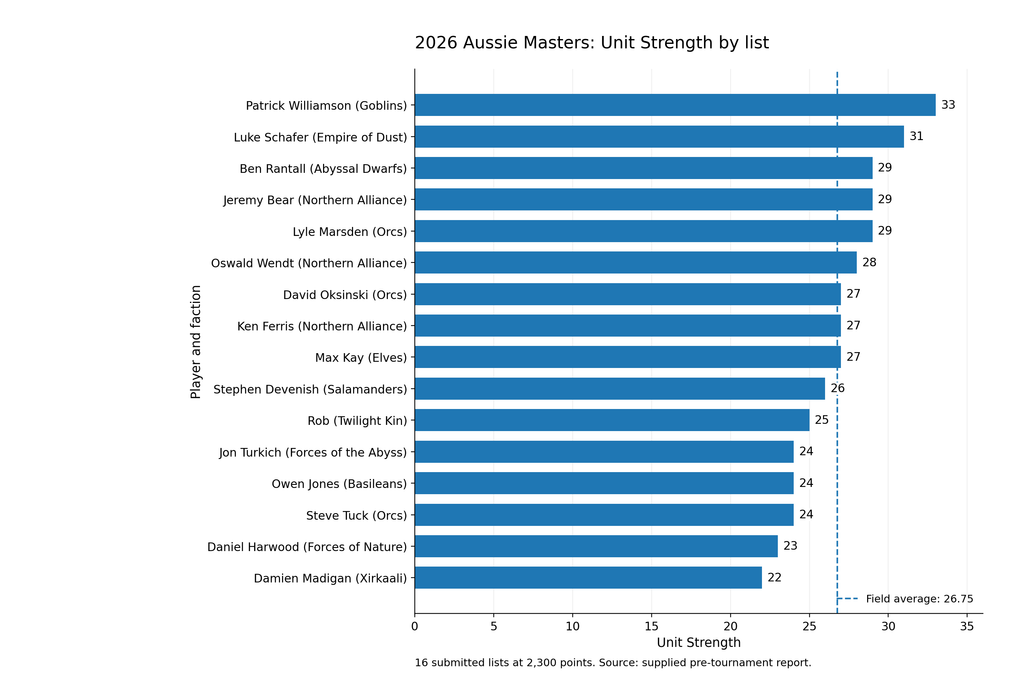
Patrick Williamson’s Goblins lead with 33 Unit Strength, ahead of Luke Schafer’s Empire of Dust at 31; the field average is 26.75.
Patrick brings 15 units, tying the largest armies here. That is a different scale from the 21–25-unit Goblin lists in my Ohio GT preview. The scoring pressure is still there, but this version adds considerable mobility. Two Fleabag Rider regiments, two Fleabag Rider Sniff troops, and a Mawbeast Pack sit alongside the Sharpsticks, Trolls, Mincer Mob, and Luggit Gang. The army’s average Speed is 7.2, tied with Max Kay’s Elves for the highest in the field. Its damage-weighted charge threat ranks third at 13.9 inches.Removing the Sharpsticks is one problem. Keeping the mobile pieces away from useful scoring positions is another. As usual, Countercharge did a great episode walking through the lists and gave this one some extra discussion.
Luke’s Empire of Dust offers a different version of high Unit Strength: 15 units, 31 Unit Strength, three Skeleton Archer hordes, and four Enslaved Guardian regiments. His list has the lowest printed damage-weighted charge threat at 11.2 inches, although Surge creates positioning problems that a basic charge-range summary cannot settle. Those two armies sit together at the top of the scoring table and could require very different answers.
Northern Alliance has a shared core, with different support
After sweeping first and second at UK Clash of Kings, all eyes are on Northern Alliance. In Australia, three players brought three wild variations on the Naiad/Clansmen/Ice Queen core.
David Walsh brings two Ice-Blade hordes, Lord on Chimera, Lord on Frostfang Snow Beast, and Ice Naiads with Brew of Strength. It plays fast and hits hard. Luke Robinson leans into survivability and shooting with two Pack Hunter regiments, Ice Naiad regiments with Brew of Strength, Trolls, Ice Queen, and a Cauldron of Blood. Ben Stoddard sits between them: Clansman hordes, Ice-Blade hordes, and Ice Naiad regiments with Brew of Strength, but no flyers. All three lists have between 26 and 28 Unit Strength.
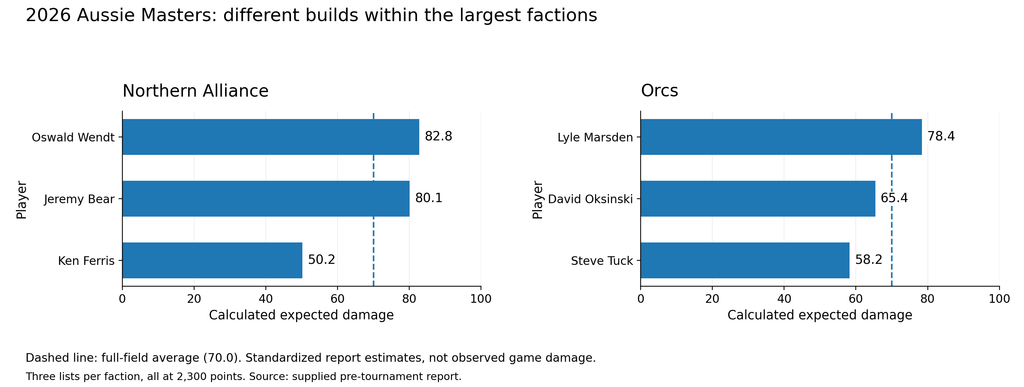
The two largest factions contain markedly different combat profiles; the dashed line shows the full-field average of 70.0 calculated damage.
Once dice hit the table, the real test is seeing which support package actually survives bad matchups. Even if Northern Alliance sweeps the weekend, these three lists are trying to win in completely different ways.
Three Orc lists, three different sets of trades
The Orc lists make the same point. Lyle Marsden has the faction’s highest calculated damage here at 78.4, with two Greatax hordes, two Gore Rider regiments, and two Ambarox. His 29 Unit Strength also gives him more scoring capacity than the other two Orc armies. David Oksinski (Orcsinski?) brings two Greatax hordes, three Skulk troops, Helstrikers, chariots, and a Stormforged Shrine. Steve Tuck takes Greatax regiments, two Riftforged Legionary hordes, two Helstriker regiments, and a Krudger on Winged Slasher. Their calculated damage comes in at 65.4 and 58.2 respectively.
Those lower totals are reasons to examine how the lists work. Where are the screens? Which units can threaten a flank? What can keep scoring after a hammer dies? The UK COK results gave us another reminder that impressive Orc combat numbers do not automatically become an exceptional faction win rate. I am interested in whether these different delivery packages change that story.
Shooting has to account for what comes back
My classifier labels nine of the 16 lists as Gun Lines. That is a broad label (shooting seems to keep going up and up as the edition rolls forward). Max’s Elves, for example, have two Palace Guard hordes, Stormwind Cavalry, and three Drakon Rider troops alongside their shooting. They also lead the damage-weighted charge-threat table at 14.2 inches. Walking toward the archers does not make the rest of that army disappear. Ben Rantall’s Abyssal Dwarfs combine an Angkor Heavy Mortar and Katsuchan Rocket Launcher with Halfbreeds, Orc Gore Riders, and Ratkin Slave Tunnel Runners. Damien Madigan’s Xirkaali bring two mortars alongside Lionsnarl Cavalry and Wildfangs. I would expect the interaction between shooting and those countercharge pieces to matter more than the archetype label.
At the other end, Jon Turkich’s Forces of the Abyss have no listed ranged attacks and the highest calculated damage in the field at 84.5. Three Moloch regiments, two Succubi regiments, Abyssal Horsemen, and an Archfiend give opponents plenty to manage once the distance closes.
There is a smaller preparation note here too: Sir Jesse’s Boots of Striding appear in 12 of 16 lists, which mirrors what we’re seeing in every other tournament. That suggests a lot of players are paying attention to getting their important units through terrain. I would check which unit is wearing them before relying on a piece of difficult ground to protect an approach.
What I want to check after the event
- Which Northern Alliance support package holds up? The shared infantry core gives us a useful starting point, but the flying pieces, shooting, healing, and combat support differ.
- Can the Orcs deliver their damage while preserving scoring units? Lyle has the highest output and Unit Strength of the three. David and Steve offer different ways to manage the approach and the trades.
- Do Patrick and Luke convert their Unit Strength into scenario results? They lead the same metric through different combinations of mobility, bodies, shooting, and support. And if Luke can win with EoD, does that provide a new path forward for a much-maligned faction?
- Can the shooting lists control the approach without conceding the decisive fights? Max’s combined-arms Elves and Jon’s combat-heavy Abyss make that a particularly interesting question.
Discover more from Data & Dice
Subscribe to get the latest posts sent to your email.