A few days before the 2026 US Masters field came into focus, George O’Connell posted a set of public predictions on Fanatics. His basic read was simple: Fourth Edition might produce a noticeably more concentrated Masters field. He guessed that at least two factions could hit double digits, that the top four factions could make up close to half the room, and that a lot of factions might end up with one or zero players.
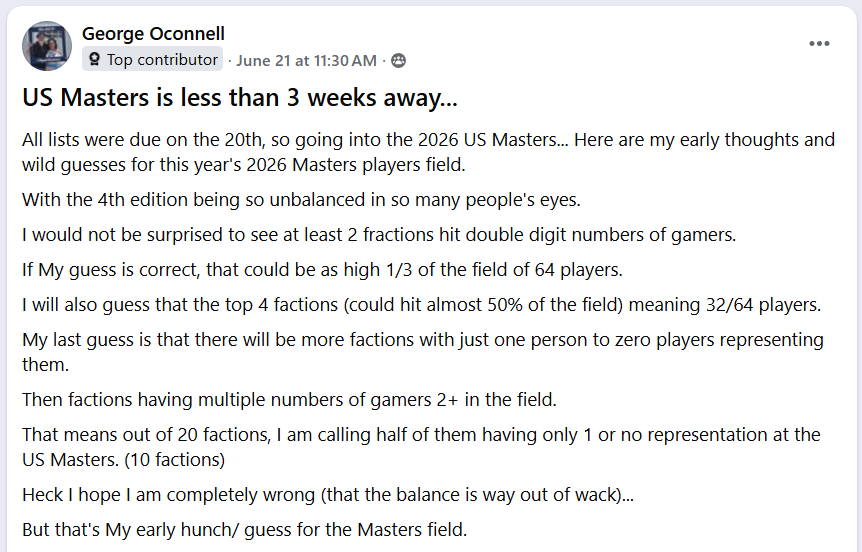
That is worth highlighting on its own. It is easy to have opinions after the lists are posted. It is harder, and more useful, to put a prediction out in public ahead of time and let the numbers judge it later. As the adage goes, predictions are hard, especially about the future. But this one gives us a useful way into the data:
I wrote about the broader faction-diversity issue recently in Early 4E Faction Diversity Looks Narrower, But the Comparison Is Messy. The same caution applies here. Fourth Edition changed the faction menu. That means HHI and faction count are useful, but they are not perfect apples-to-apples measurements.
Still, Masters is worth looking at closely. This is a strong field, and players generally bring lists they trust. The pre-tournament report does not tell us what will win, but it does tell us what players think is worth putting on the table.
You can review the submitted 2026 lists here: 2026 US Masters list folder.
TL;DR
The 2026 US Masters field is more compressed than the 2024 and 2025 fields. There are fewer factions represented, the top factions take up more room, and magic item choices are much more concentrated. Some of that was expected because Fourth Edition changed the available buckets. The useful question is whether this is normal early-edition sorting, or the first sign of a narrower competitive toolkit.
The dataset
This article uses the pre-tournament list reports from the last three US Masters fields:
A small method note before the charts: HHI measures concentration. Higher HHI means more of the field is taken up by the same few factions or items. In plain Kings of War terms, it asks how much of the room is clustered around the same choices. HHI does not prove balance problems; it is a field-shape metric. That distinction matters more than usual here because 2026 is a Fourth Edition field, while 2024 and 2025 were Third Edition fields.
| Year | Lists | Factions | Faction HHI | Top 4 Faction Share |
|---|---|---|---|---|
| 2024 | 63 | 22 | 647.5 | 39.7% |
| 2025 | 64 | 25 | 581.1 | 35.9% |
| 2026 | 64 | 18 | 761.7 | 42.2% |
The field is more compressed
The first read is straightforward. The 2026 field has fewer factions represented than either of the prior two US Masters fields. It also has the highest faction HHI of the three-year set. The top four factions account for 42.2% of the 2026 field. That is up from 39.7% in 2024 and 35.9% in 2025. That points toward a more concentrated field.
The caveat is also straightforward. Fourth Edition has fewer faction buckets. If the game gives players fewer labels to spread across, concentration will naturally rise. A perfectly even 20-faction event will have a higher HHI than a perfectly even 29-faction event. So I would be careful with the strongest version of the claim. This data does not prove that Fourth Edition is less diverse in a balance sense. It does show that the 2026 Masters field is occupying fewer competitive buckets.
The Masters meta turned over
The faction names changed more than the concentration score. The 2024 and 2025 Masters fields were shaped by Nightstalkers, Northern Alliance, Dwarfs, Twilight Kin, Ogres, and several 3E-era tools that either changed, moved, or disappeared as separate labels. The 2026 field has a different top layer.
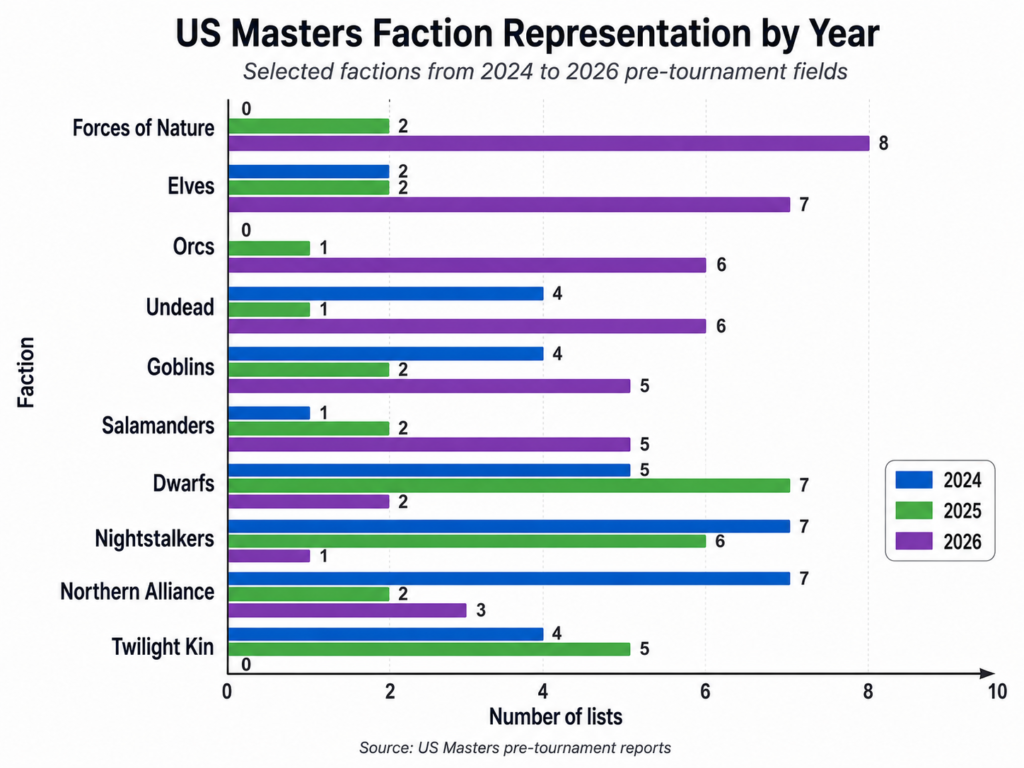
This table needs the same taxonomy warning. “Orcs” in 2026 is not a clean match for how Orcs and Riftforged Orcs existed as separate 3E labels, as did others that changed with the edition shift. So I would read this as a comparison of report labels, not a perfect faction-history chart. Even with that warning, the movement is large enough to matter.
Forces of Nature leads the 2026 field with eight lists. Elves jump to seven. Orcs and Undead each have six. Goblins and Salamanders each have five. Meanwhile, Nightstalkers drop from seven lists in 2024 and six in 2025 to one in 2026. Dwarfs drop from seven in 2025 to two in 2026. Twilight Kin had five lists in 2025 and none in the 2026 report. That looks like an edition reset.
Some of this is likely practical. Early in a new edition, players often lean toward armies with clear roles and reliable tools. They want lists that can score, trade, and handle messy matchups without needing every edge case solved. The 2026 top factions mostly fit that description.
Forces of Nature is the early 4E headline
Forces of Nature is the easiest faction to point at. It had no lists in the 2024 report, two in 2025, and eight in 2026. That is the largest 2026 faction count. The more useful point is that Nature does not appear to be one narrow build. The 2026 report tags Nature lists across several styles, including grind, trash, balanced, and gunline-style approaches. A faction with one obvious build is easier for the field to prepare for. A faction with multiple viable shells asks a different question. You might know you are playing Forces of Nature, but that does not mean you know whether the list is trying to grind, flood the board, shoot, or play a more balanced control game.
For players, the takeaway is practical. If you are going to Masters, or preparing for similar 4E fields, “have a plan for Nature” is probably too vague. You need to know which kind of Nature list you are trying to answer. The post-event data will tell us whether the high representation turns into strong results. Right now, the pre-event data tells us that a lot of strong players believe the book has tools worth trusting.
Item choices compressed even more
The faction data is only half the story. Magic item selection shows an even clearer compression pattern.
| Year | Distinct Items Used | Item HHI | Most Common Item | Count |
|---|---|---|---|---|
| 2024 | 42 | 490.9 | Blade of Slashing | 24 |
| 2025 | 44 | 390.2 | Sir Jesse’s Boots of Striding | 19 |
| 2026 | 31 | 725.0 | Sir Jesse’s Boots of Striding | 35 |
The number of distinct items drops from 42 in 2024 and 44 in 2025 to 31 in 2026. Item HHI rises from 490.9 in 2024 and 390.2 in 2025 to 725.0 in 2026. That is a clear shift. Some of it may come from the Fourth Edition item list itself. Fewer or different options will naturally narrow the spread. Unit rules, terrain rules, points costs, and army construction also affect what upgrades are worth taking. Still, the 2026 pattern is hard to miss. The top item is taking up much more room. Sir Jesse’s Boots of Striding appeared 23 times in 2024 and 19 times in 2025. In the 2026 report, Boots appear 35 times. That is more than half the field.
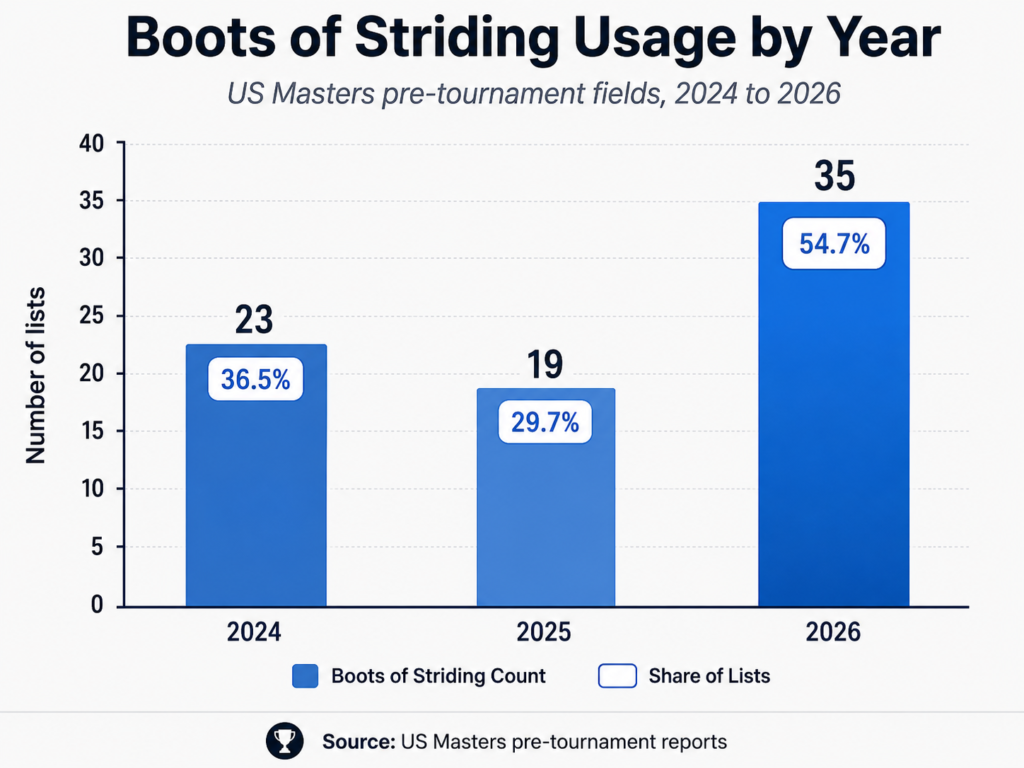
That tells us something about what players expect from 4E games. Boots are not a raw damage item. They are a delivery item. Players are paying for reliability through terrain, which suggests they expect key trades to be decided by whether the right unit can get to the right place at the right time. That is very Kings of War. The best hammer in the world still needs to land.
What item compression might mean
Magic items are one of the places where list builders reveal their assumptions. A damage item says the unit needs to hit harder. An Inspiring item says the list needs another support point. Boots say the unit needs to arrive reliably. When 35 of 64 lists take the same delivery tool, that is a field-level signal. It does not automatically mean Boots are too good. It may mean the item is solving one of the most common table problems in 4E.
High usage can come from imbalance, but it can also come from universal usefulness. Terrain is present in every game. Key charges decide games. Scenario pressure often forces units through awkward lanes. Boots help with all of that. The question is whether this broad usage persists after players get more reps in the edition. Early-edition metas often start with safe choices. Players identify the clean upgrades first, then spread out later as they learn the edge cases. If item variety opens up over the next few large events, the 2026 Masters item spread may end up looking like normal early-edition sorting. If Boots stay above 50% usage, then the item environment may be more constrained than it first appears.
The practical read
The 2026 US Masters field is more compressed than the prior two Masters fields. That compression shows up in three places:
- Fewer faction labels represented.
- More of the field concentrated in the top factions.
- Much tighter magic item selection, especially around the J-boots.
The careful read is important. This does not prove that Fourth Edition has a diversity problem. The faction menu changed, and some increase in concentration was expected before anyone submitted a list. But the player behavior still matters. Strong players are clustering around certain factions and certain item solutions. Forces of Nature, Elves, Orcs, Undead, Goblins, and Salamanders make up a large part of the field. Boots of Striding show up in more than half the lists. For players, the takeaway is clear enough: prepare for reliable delivery, flexible mid-board pressure, and fewer oddball item packages than we saw in 2024 and 2025.
For the broader meta, I would watch what happens after results come in. If the top finishers are spread across factions and item packages, this may just be early-edition caution. If the most represented factions and items also dominate the standings, then the compression story gets more interesting.
I am saving two other questions for a follow-up article: Goblins as the scenario stress test, and whether 4E Masters lists are hitting harder than the prior two fields. Those deserve their own space. For now, the 2026 US Masters looks like the first serious test of how compressed early Fourth Edition really is.
As always, given the nature of parsing malformed pdf lists, I almost certainly have made a handful of data integrity mistakes around the margins. I’m happy to adjust and fix them if you point it out, but I’m likely too lazy to track that down myself. Consider the analysis directionally accurate.