Countercharge has argued that a new 4th edition is needed to reinvigorate Kings of War. I looked at UK tournament data from kowmasters.com to see what event and player participation can tell us about the scene. Both dipped during the pandemic and have since increased.
Data Overview
The dataset provides details on tournament events, players, and their chosen factions across multiple years. By examining trends in total events, total player entries, and unique player participation each year, we can capture a snapshot of the game’s health and growth trajectory.
1. Total Events per Year
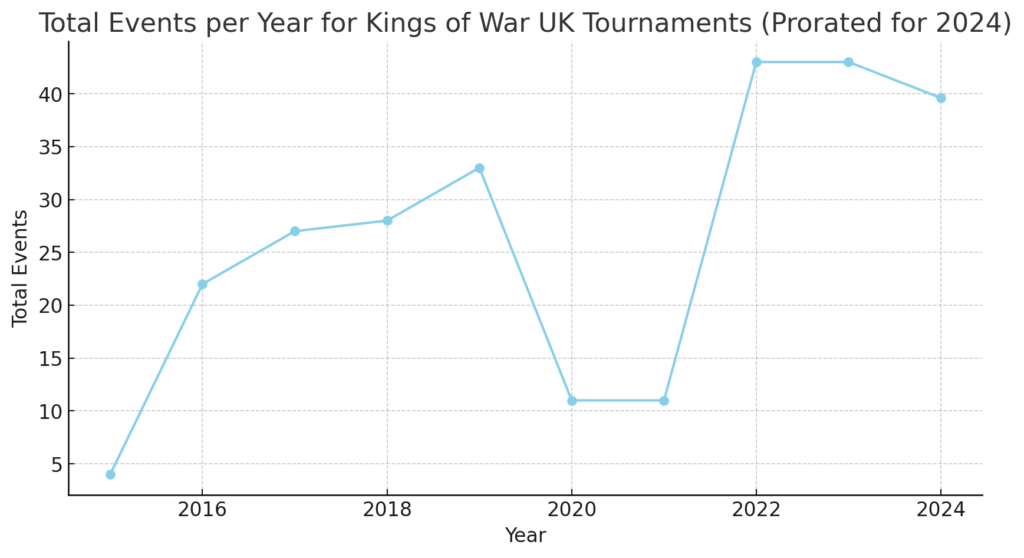
An essential metric in the analysis was the number of events hosted each year. Predictably, there was a dip in events in 2020, but 2021 saw a quick rebound as players returned to in-person play. Since then, the total number of events per year has been steadily increasing, indicating that organizers are ramping up opportunities for players to engage and compete.
2. Total Players per Year
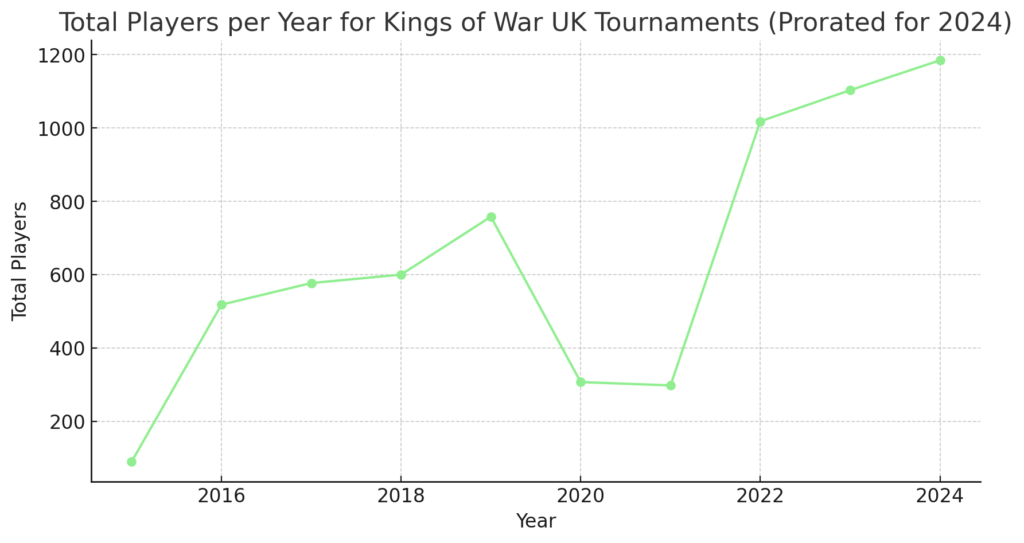
Total player entries show participation across events. Entries in 2023 and 2024 were the highest since tracking began. These totals reflect both event count and attendance, so they do not show whether the average event was larger.
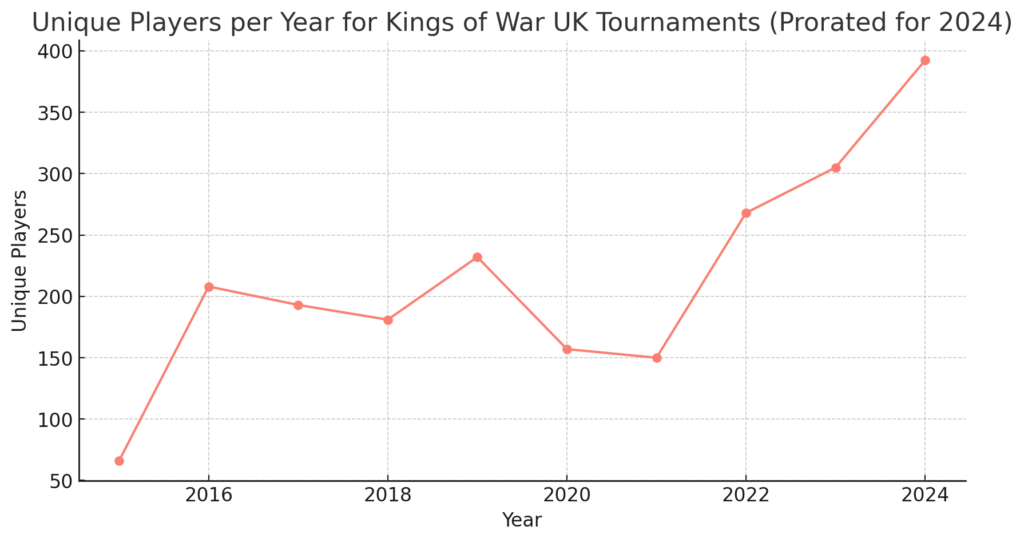
3. Unique Players per Year
Unique-player counts provide another view of participation. The number of unique players has grown steadily since 2020, and the prorated 2024 total is already higher than any previous year. This suggests participation is spread across more players, though the count does not distinguish newcomers from returning players.
Is the Scene Really Growing?
The UK tournament data shows growth in events and player participation since the pandemic. It describes organized play in one region; it does not answer whether a new edition is needed or show how the game is doing worldwide. Countercharge has raised the wider question, and UK results are one part of that discussion.
Community Diversity: A Look at HHI
I also calculated the Herfindahl-Hirschman Index (HHI) for each year to measure how tournament participation is distributed among players. A lower score means entries are less concentrated among a small number of players. HHI does not show whether those players are new or returning.
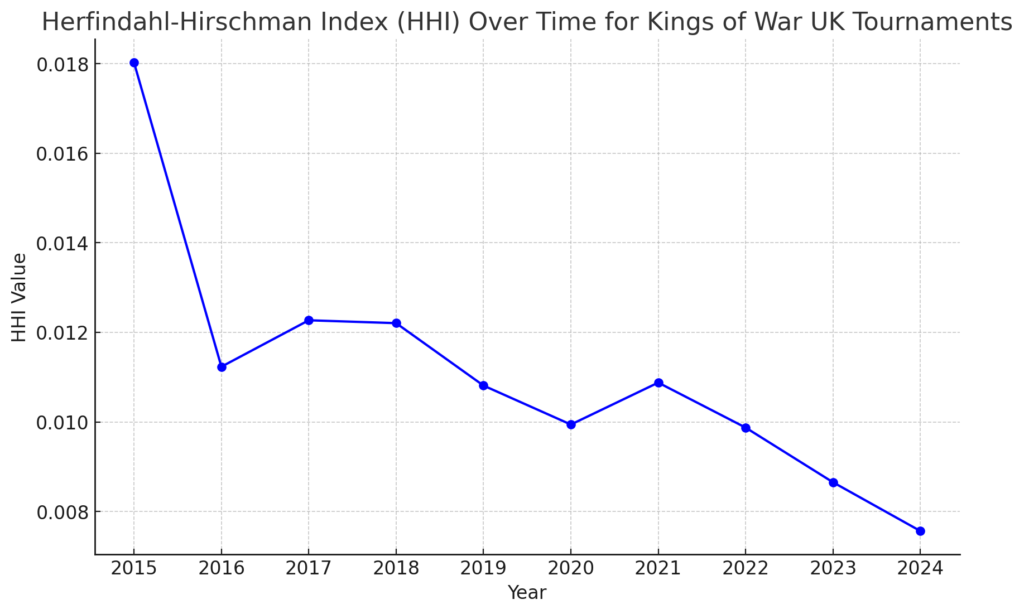
The HHI has decreased over time, so UK tournament entries are less concentrated among a small number of players. That is consistent with broader participation, but the index alone cannot establish the long-term health of the game.
Player Retention and Growth
Finally, I wanted to take a look at player retention and turnover. By examining new players, returning players, and dropped players for each year, we can see how the community evolves over time. The data reveals interesting dynamics in the player base:
- New Players: Each year, we see a healthy influx of new players. This metric helps demonstrate the attractiveness of the game and the ability of the community to draw in fresh participants.
- Returning Players: The number of players who return each year indicates the game’s stickiness and how enjoyable players find the competitive scene.
- Dropped Players: By tracking players who participate one year but not the next, we can identify potential areas of concern where engagement may need reinforcement.
The table below shows the number of new, returning, and dropped players by year:
| Year | New Players | Returning Players | Dropped Players |
|---|---|---|---|
| 2015 | 66 | 0 | 11 |
| 2016 | 153 | 55 | 98 |
| 2017 | 83 | 110 | 76 |
| 2018 | 65 | 117 | 58 |
| 2019 | 109 | 124 | 131 |
| 2020 | 45 | 95 | 138 |
| 2021 | 72 | 100 | 48 |
| 2022 | 93 | 125 | 89 |
| 2023 | 120 | 130 | 75 |
| 2024 | 134 | 142 | 102 |
Since 2020, the counts of new and returning players have increased each year, alongside some year-to-year drop-off. Together, these figures show more people entering and returning to UK events, as well as ongoing turnover.
Final Thoughts
By event count and player participation, the UK scene has recovered since the pandemic. The 2024 figures are prorated, so they may change by year-end. Tournament data is one measure of activity and cannot establish the game’s long-term health.
Countercharge’s concern is about the health of the game overall; this dataset covers UK tournaments. The figures show growth in organized play here, and continued tracking will show whether that pattern holds. Other regions need their own data before drawing a wider conclusion.