I just wrapped up a game with TastyBagel over at Regnum Aeternum. While we were playing, we were musing on the changes to shooting for 4th edition. When 4th edition was announced, one of the loudest early reactions was that shooting was dead. Not weakened. Not adjusted–dead. That always felt a little too clean to me. Kings of War players are very good at finding edges, and if shooting still created reliable value, tournament players were going to keep bringing it. If it did not, they were going to move those points somewhere else. So I looked at the data from two angles:
- First, the tournament level: are players actually bringing less shooting in 4th Edition?
- Second, my own tracked games: when ranged units are on the table, are they still doing damage?
Those are not the same question. One is about list-building behavior. The other is about battlefield output. Taken together, they tell a more useful story than “shooting is dead.” They suggest shooting has moved from a dependable army-building pillar to something narrower, swingier, and more context-dependent.
TL;DR
4E did not kill shooting, but it clearly reduced tournament investment in it. Players are bringing much less shooting, and my personal data suggests ranged damage is now swingier and less dependable. Shooting still matters, but it has shifted from backbone to specialist tool.
The Tournament Signal: Players Are Bringing Less Shooting
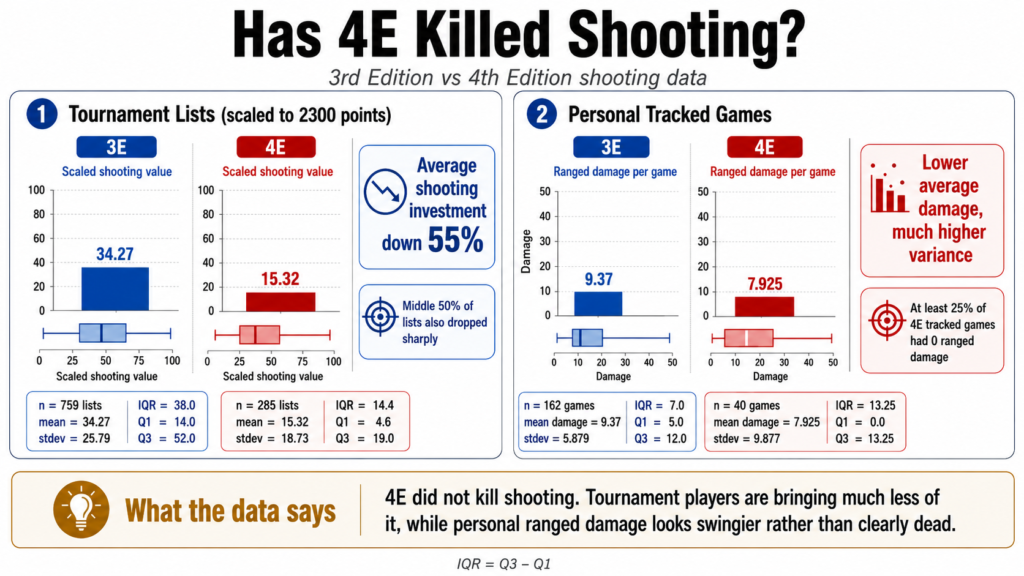
For tournament lists, I scaled shooting values (i.e. number of ranged shots brought in a list) to 2300 points to make the 3rd Edition and 4th Edition data easier to compare.
| Edition | Lists | Mean Shooting | Stdev | Q1 | Q3 | IQR |
|---|---|---|---|---|---|---|
| 3rd Edition | 759 | 34.3 | 25.8 | 14.0 | 52.0 | 38.0 |
| 4th Edition | 285 | 15.3 | 18.77 | 4.6 | 19.0 | 14.4 |
The average tournament list is bringing about 55% less shooting once scaled to 2300 points. That is not a small adjustment. That is a major shift in how competitive players are building armies. The IQR matters too. In 3rd Edition, the middle half of lists ranged from 14 to 52 shooting. In 4th Edition, that middle band shrinks to 4.6 to 19. That means shooting is not just lower on average but is less central to the normal tournament list.
This is probably the cleanest signal in the whole dataset. Tournament players are not behaving as if shooting is secretly fine and everyone is just missing it. They are investing far fewer points into it.
The Personal Data: Damage Is Lower, But the Bigger Story Is Variance
I track unit performance in all my games (why, might you ask? I don’t know. I just do. On the plus side, if you follow my most frequent opponent’s blog at Regnum Aeternum, you’ll see I’m in good company when it comes to tracking data while gaming). My own tracked games show a different but related pattern.
| Edition | Games | Mean Ranged Damage | Stdev | Q1 | Q3 | IQR |
|---|---|---|---|---|---|---|
| 3rd Edition | 162 | 9.4 | 5.9 | 5.0 | 12.0 | 7.0 |
| 4th Edition | 40 | 7.9 | 9.9 | 0.0 | 13.3 | 13.3 |
In my own tracked games, ranged damage is down from 9.4 to 7.9. That is a decline, but I would be careful not to overstate it. The 4E sample is only 40 games, and the spread is much wider.
The real story is consistency.
In 3rd Edition, ranged units tended to contribute something. The middle half of results ran from 5 to 12 damage. In 4th Edition, the lower quartile is 0. That means at least a quarter of tracked games had no ranged damage contribution.
But the upper quartile is 13.3, higher than 3rd Edition’s Q3. So when shooting does work, it can still work. That is not death. That is volatility. Partially I’m leaning more heavily on war engines (here’s to cannons hitting on 4s when staying still), so increased variance makes sense instead of large hordes of bowmen or whatever else.
So What Changed?
The data suggests players are not treating shooting as a default tournament investment anymore. They are treating it more like spice than backbone.
In 3rd Edition, shooting could often function as a steady pressure tool. It removed chaff, softened hammers, forced bad movement choices, and created value before combat started.
In 4th Edition, the value seems less automatic. If shooting is less efficient, less reliable, or harder to protect, then players will naturally shift points into units that score, fight, survive, or project board control more directly.
That does not mean ranged units are bad. It means the burden of proof is higher.
A shooting unit now needs a clear job:
- Does it remove chaff?
- Does it threaten scoring units?
- Does it force movement mistakes?
- Does it support a specific combat plan?
- Does it still matter in scenarios where damage alone is not enough?
If the answer is “it might do some wounds,” that probably is not good enough anymore.
Shooting as Spice, Not Backbone
This is the part that matters for list-building: a shooting unit can still be useful if it supports the army’s real plan. It can clear cheap screens (though make sure you’re doing enough damage to actually remove the unit). It can punish careless movement. It can chip damage onto a unit that your combat pieces are already planning to finish. It can force an opponent to respect a part of the board they would otherwise ignore.
But if shooting is the plan, the data is much less encouraging. The tournament data says players are bringing less of it. My game data says the damage output is less dependable. Those two things fit together pretty well (and aligns with this discussion on OnTableTop).
The successful 4E shooting pieces are probably going to be the ones that do more than shoot. They score. They survive. They project threat. They bring utility. They contribute to scenario play even when they don’t have great targets. The units that only stand still and hope the math works may have a harder time earning their keep.
What This Means for the 4E Meta
The early 4E shooting conversation was framed too dramatically. “Dead” is easy to say. It is also usually wrong. The better answer is that shooting appears to have lost a lot of its default tournament value. Players are bringing much less of it, and the personal damage data suggests it may now be more feast-or-famine than steady pressure.
That may be good for the game if it keeps Kings of War focused on movement, scenario pressure, and combined arms. A game where every army is forced to move, trade, screen, and fight is probably healthier than a game where ranged pressure solves too many problems from too far away.
But there is a balance question hiding underneath that. If shooting becomes too unreliable, some ranged units may simply disappear from competitive play. That is not ideal either. Kings of War is better when armies have real choices, not when entire categories of units become decorative.